

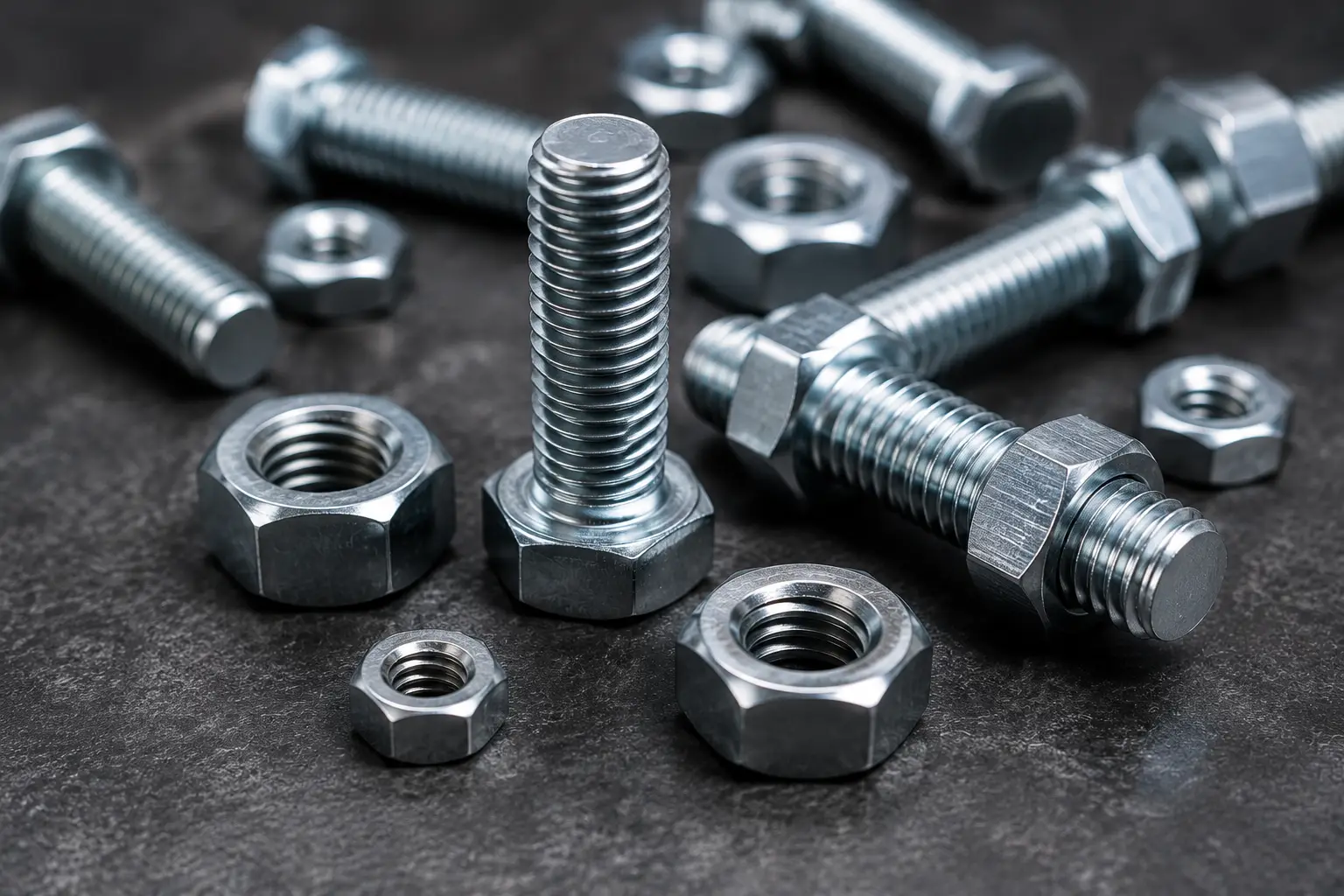
When sourcing components for heavy engineering, infrastructure, or automotive projects, selecting the right industrial fasteners is critical. A common dilemma for procurement managers and engineers is choosing between Grade 8.8 and Grade 10.9 bolts. While they may look identical, their mechanical properties and applications differ significantly.
Understanding these differences ensures structural integrity, safety, and cost-efficiency.
What do the numbers mean?
The grades 8.8 and 10.9 are standardized metric strength classifications.
- Grade 8.8: Represents a nominal tensile strength of 800 MPa, with a yield strength of 640 MPa (80% of tensile).
- Grade 10.9: Represents a nominal tensile strength of 1000 MPa, with a yield strength of 900 MPa (90% of tensile).
Performance Comparison: 8.8 vs. 10.9
| Feature | Grade 8.8 Fasteners | Grade 10.9 Fasteners |
| Material | Medium-Carbon Steel | Alloy Steel |
| Tensile Strength | 800 N/mm² | 1040 N/mm² |
| Yield Strength | 640 N/mm² | 940 N/mm² |
| Application | General Hardware | Heavy Engineering/Structural |
| Hardness | Moderate | Superior |
When to Choose Grade 8.8
Grade 8.8 bolts are the industry standard for general construction and machinery where moderate strength is required. They are highly economical and offer excellent wear resistance for standard static load applications. If your project involves non-critical structural connections, Grade 8.8 is often the most cost-effective solution.
When to Choose Grade 10.9
Grade 10.9 fasteners are the “power bearers” of the industry. Because of their higher alloy content and specific heat treatment (quench and temper), they are built for extreme conditions.
- High-Frequency Alternating Loads: Ideal for engines and vibrating machinery.
- Structural Infrastructure: Bridges and large-scale steel buildings that require higher load-carrying capacity.
- Safety-Critical Connections: Where failure is not an option.
Why Quality Manufacturing Matters
At JVS Fasteners, we understand that a bolt is only as good as its manufacturing process. Whether you require high-tensile 10.9 bolts or standard 8.8 hardware, precision in thread forming and surface coating (such as hot-dip galvanizing or zinc plating) is vital to preventing corrosion and hydrogen embrittlement.
Conclusion: Selecting the Right Solution
Choosing the right high-tensile fasteners doesn’t just improve safety; it optimizes your project budget by ensuring you aren’t over-engineering a simple application or under-engineering a critical one.
Need expert advice for your next project? As a leading bolts and nuts manufacturer in India, JVS Fasteners provides custom-engineered solutions for diverse industrial sectors. [Click here to view our product catalog or contact us for a bulk quote].
Strategy for Consistency
To keep your blog growing and ranking, implement this strategy: